If you write code or analyze data, you are living through the greatest cognitive offloading experiment in human history. But away from the headlines, a much more personal crisis is playing out on our monitors. It’s happening in code reviews, design docs, and troubleshooting sessions: our core mental muscles are starting to rust. Or worse, for the younger generation, these muscles may never develop as AI removes friction and obfuscates process details.
As someone who builds AI tools and works in biomedical data science, I see both sides of the coin. I love the support these tools provide. But I am also aware that our minds can fall into a trap, what aviation engineers call automation complacency. When a pilot relies on autopilot for too long, manual flying skills atrophy. More dangerously, pilots lose their internal “mental model” of the system, making them helpless the moment something unexpected goes wrong.
When you remove all the friction and frustration from technical work, you remove the very resistance that builds your intuition and meta-skills.
Domain experts benefit more from the AI
Automation doesn't affect everyone equally and this puzzled me for a while. I assumed that once AI agents capable of assisting with code arrived, everyone in our lab would become infinitely more productive. But productivity didn't rise across the board, even though everyone adopted agentic AI in some form. The seniors in the lab consistently obtained far more value from the AI tools than juniors.
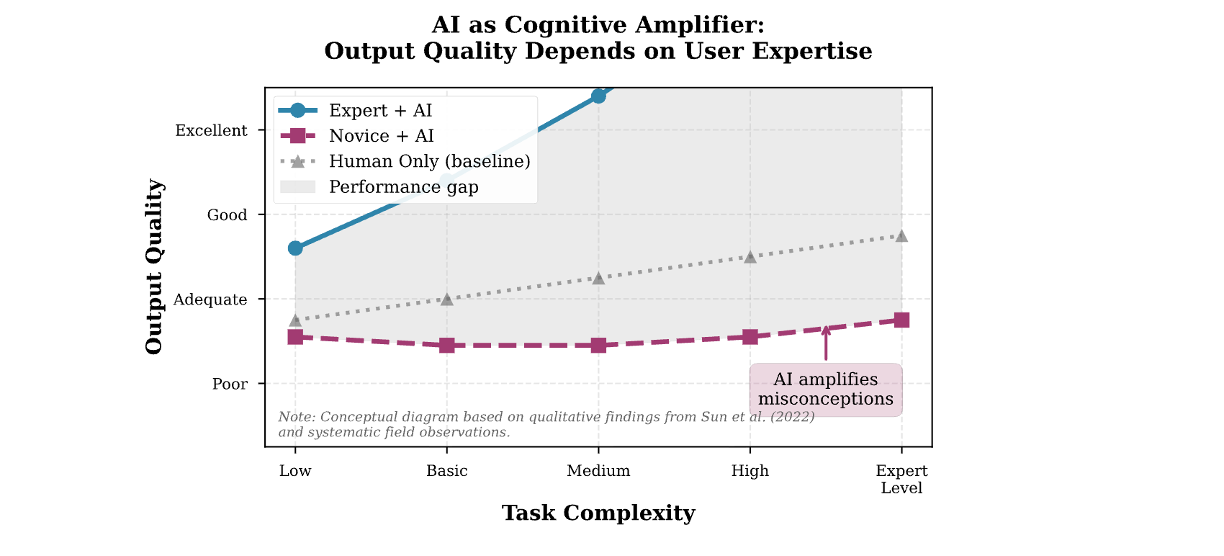
The clues lie in recent findings by Dell’Acqua et al. and Tao An. What those papers argue is that the AI has a context specific effect on output quality. It depends on task complexity and user’s domain expertise. For low complexity tasks, it acts as an equalizer. Now everyone can make a nice figure or a web page just by prompting. But for high-complexity tasks, experts benefit more. Why is that though?
Research work wether wet-lab or computational needs experimentation and cycling through ideas that are born out of failures or past experiences. Pre-AI, we had time, expertise and intuition to explore only a few ideas. With AI, we can explore far more ideas or paths regarding a research problem. However, being able to explore more doesn’t mean you know where to go. You need the domain expertise and intuition, possibly build through failures, to steer your research to productive paths.
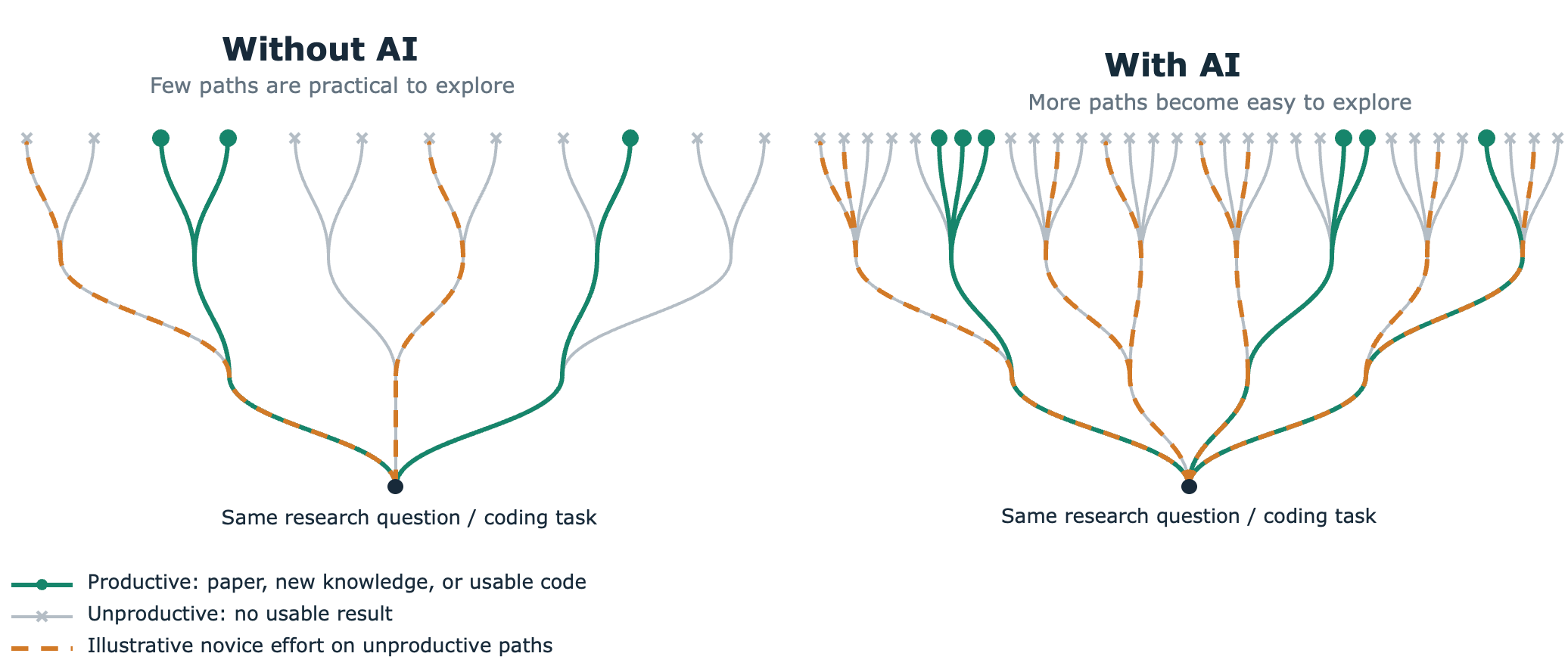
Seniors already possess the internalized mental models needed to decompose problems, steer the models, and spot subtle hallucinations or drift from initial goals; juniors possibly lack that reference frame. AI has taken over the routine mechanics of coding. What’s left are the meta-skills: the higher-level abilities that govern how we think, how we come up with tests, formulate hypotheses, and know when a system is lying to us.
The recruitment test born out of necessity
If meta-skills are the only differentiator that matters, traditional coding challenges that we used to send to candidates are obsolete. AI solves them instantly. That’s why I had to invent a test for raw reasoning and critical thinking.
The mechanics of the test were trivial: You provide input variables and you observe one output. To solve it, a candidate had to reverse-engineer the hidden mathematical rule by running tests and observing the responses. I assumed experienced engineers, data scientists, and sharp graduates would breeze through it. However, many smart candidates repeatedly failed in predictable ways: changing multiple variables at once, ignoring edge cases, and guessing from memory rather than tracking results.
When we outsource our thinking to AI that fails with fluent confidence, we will forget how to systematically interrogate a black box. If systematic reasoning is an atrophied skill, how do we train it when software removes all friction?
Three rules for “deliberate friction”
If we want to stay sovereign over our work instead of becoming passive passengers, throwing away our tools isn't the answer. We have to introduce deliberate friction into our training and daily habits. Just as physical workouts became essential once manual labor was automated, we now need cognitive calisthenics to keep our technical meta-skills sharp.
Here is how you can practice it starting today:
1. Start with a blank page
Never hand a raw, unstructured problem straight to an AI prompt. Before you open a screen or type a query, spend 10 minutes with a physical pen and a piece of paper. Sketch out your hypothesis, map the state transitions, or write down what you think is causing the bug. The physical act of structuring a thought before a machine touches it builds the neural pathway required to audit the machine’s output later. You cannot edit what you do not understand.
2. Probe the boundaries, don’t take the easiest path
When troubleshooting an unfamiliar system, be it an AI-generated script, or a third-party report, humans usually only test what confirms our biases. We check if it works for standard inputs. An adversarial thinker does the opposite. You must actively hunt for the breaking point: What happens at zero? What happens with negative values? What if I inject a decoy variable? True understanding of a system lives at the edges, not in the middle.
3. Own the hypothesis, outsource the legwork
Let AI handle the mechanical tasks such as formatting data, scaffolding boilerplate, scraping documentation, or translating your rough logic into code. But never outsource hypothesis formation or verification to AI. If the machine writes both the core implementation and the tests, you are living in a closed loop of hallucinated confidence.
Test your own skills
Reading about cognitive fitness is like reading about lifting weights, it doesn’t build any muscle unless you do the reps.
To see how your own troubleshooting meta-skills hold up under pressure, I’ve adapted our black-box recruitment diagnostic into a short, 3-round interactive challenge called Beat the Black Box.
Grab a pen and paper, see if you can make it through.
👉 [Play the “Beat the Black Box” here]